


The Dance of the Dakinis
Cycle of Five Years of Teachings
Residential Retreats with Carlos de León
First Year
Arachova, Greece 1-6 July 2026
Dakini in Sanskrit, Khandro in Tibetan, literally means "sky dweller" or "sky dancer", and is the most sacred aspect of the feminine principle in Tibetan Buddhism, embodying both humanity and divinity in feminine form. The Khandroma, usually volatile or quick-tempered, acts as a spiritual muse for spiritual practice
The Dakinis are energetic beings in feminine form, who evoke the movement of energy in space. In this context, the sky or space indicates Sūnyatā, the insubstantiality of all phenomena, which is, at the same time, the pure potentiality of all possible manifestations
In Dzogchen, when considered as a stage on the Vajrayana Path, the Dākinī is the final stage:
-
Τhe first is the guru, which corresponds to the initial realization of the true condition of reality, as this is introduced by the guru in empowerment
-
The second is Yidam, which corresponds to meditation in that devata, is the method used to develop the state discovered in the initial realization of the true condition of reality
-
The third stage is the Dākinī, insofar as the Dākinī is the source of activities based on guru realization and devata meditation
As the Base, the Dākinīs are the energies of life; as the Path, they are the activities of advanced practitioners; and as the Fruit, they are the actionless activities of the realized Masters. The Dakinis are an essential part in Vajrayana and Dzogchen experience, they had protected, revealed and inspired the teaching and their practitioners in all the different lineages through all the eras. Their practices are considered some of the most profound, graceful, swift and blissful that we can learn
In disturbed times such as this one, Dakini practices are considered most valuable and effective
First Year:
Fundamentals with Vajrayogini, Tara, Ekajati
-
Introduction to Dakini practice
-
Invocation Dakinis and Ekajati , Guru Yoga and Self-empowerment
-
Dzogchen Chi kung
-
Dakini Yogas
-
Illusion Body Yoga
-
Clear Light Yoga
-
Tara
-
Longevity
-
Wealth
-
Heart Essence of the Dakini 6 Sutras (Bonpo Text)
-
Essential Guru Yoga practice with Vajrayogini
Vajrayogini
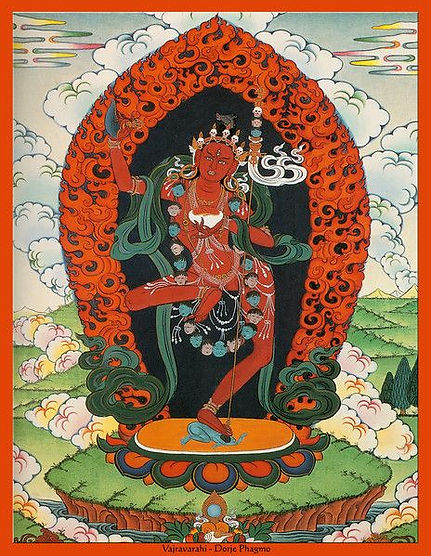
Vajrayoginī is a Tantric Buddhism Buddha and a Dākiṇī. The essence of Vajrayoginī is "great passion", a transcendent passion that is free from egoism and delusion: it works intensely for the welfare of others and for the destruction of ego-clinging
Vajrayoginī sādhanā originated between the 10th and 12th centuries in the context of Hindu Shaiva tantras. Buddhist yogini tantras dealing with yoginis and Dakinis are based on Saiva scriptures. Vajrayoginī / Vajravārāhī , is a representation of complete Buddhahood in a female form. Classified as Wisdom or 'Mother' Anuttarayoga Tantra, the practices originate with the Chakrasamvara Cycle of Tantras. Vajrayoginī , as Heruka 's consort Chakrasamvara , is the very essence of the Chakrasamvara Cycle of Tantras
In the Cakrasaṃvara Tantra, Vajrayoginī appears as his consort yab-yum, to become an independent practice of Anuttarayoga Tantra in its own right. Vajrayoginī practice belongs to the Mother Tantra class of Anuttarayoga Tantras along with other tantras like Cakrasaṃvara and Hevajra Tantras
Vajrayogini is the female Buddha who takes forms, like a dancing Dakini , like a fierce, joyful, wrathful warrior, like a compassionate mother, single or embraced by her consort. She is the symbol of the vibrant intrinsic power of altruistic love and radical clarity
Vajrayogini is said to be ideal for those with a strong and passionate nature, as it represents the transformation of ordinary desire into joyful, altruistic and enlightened intention. In the path of Buddhist tantra, instead of giving up mental afflictions, one harnesses them, transforms them, and releases them into the qualities of innate wisdom
For Vajrayogini, this focuses on the transformation from ordinary grasping and clinging, to altruistic, supreme love, It focuses on the transformation of our identity and the re-inhabitation of the experience embodied in the energy of the yidam, the deity of meditation. it is a practice used to free the mind from the confines of its habitual reference points. This is a deep method of meditation based on the Vajrayana view of the mind, so that our identity is opened and aesthetically charged with the energies of the five wisdoms
Tara

Tara is undoubtedly the most popular female Buddha. Her name means “star” in Sanskrit and she is believed to possess the ability to guide followers, like a star, on their spiritual path. Her name in Tibetan, Jetsun Dölma, means “she that saves”
In some northern Buddhist traditions, she is considered a bodhisattva and is often described in texts and depicted in imagery as the female consort of the most widely revered bodhisattva, Avalokiteshvara
In some Buddhist legends, it is said that she was born from one of Avalokiteshvara’s tears, shed in a moment of deep compassion. Other Buddhist legends, however, tell of a devout Buddhist princess who lived millions of years ago who became a bodhisattva, vowing to keep being reborn in female form (rather than in male form, which was considered more advanced on the path to enlightenment) to continue helping others
She remained in a state of meditation for 10 million years, thus releasing tens of millions of beings from suffering. Since then, she has manifested her enlightenment as the goddess Tara.
She is referred to as the Wisdom Goddess, the Embodiment of Perfected Wisdom, the Goddess of Universal Compassion, and the Mother of all Buddhas
Ekajati

Ekajati or Ekajaṭā (Sanskrit: "One Plait Woman"; (Also known as Ngag Sungma, Mother Protectress of Mantra)
Ekajati is the supreme protectress of Ati Great Perfection Teaching, Dzogchen. She is a guardian of the tantric path and protects it from those who are unworthy
She removes obstacles to the life and accomplishment of those who do practice on the Secret Mantra path. Ekajati is the protector of secret mantras and "as the mother of the mothers of all the Buddhas," represents Absolute ultimate unity
Along with that, her ascribed powers are removing the fear of enemies, spreading Joy and removing personal hindrances on the path to enlightenment
She is considered the Queen of the Dakinis